
Introduction
A comprehensive film business plan is the difference between filmmakers who secure funding and those who struggle to finance their projects. Whether you’re developing your first indie feature, pitching to investors, or establishing a film production company, understanding how to create a professional business plan film production is essential to turning your creative vision into reality.
Many aspiring filmmakers believe a compelling script and brilliant concept are sufficient to attract investment. In reality, savvy investors and funding bodies require documentation demonstrating both creative merit and financial viability. Your film business proposal must answer critical questions: What exactly is your project? Who will watch it? How will you make money? What are the risks? How will you manage them?
This comprehensive guide covers everything required to create a professional film production business plan, including detailed explanations of essential sections, practical film business plan template guidance, real-world sample film business plan examples, and strategies for presenting your plan to secure the funding your project deserves.
What Is a Film Business Plan and Why Does It Matter?
Understanding the Fundamentals
A business plan film production is a strategic document outlining your film project’s creative vision, operational strategy, financial requirements, and revenue projections. It functions as a comprehensive blueprint addressing every aspect of bringing your film from concept to market, designed primarily to attract investors, secure financing, and guide your production through completion.
Your movie business plan serves multiple critical purposes simultaneously:
For Investors: It demonstrates you’ve completed thorough research, understand market dynamics, have realistic financial projections, and represent a sound investment opportunity.
For Yourself: It clarifies your vision, establishes concrete milestones, identifies potential problems early, and provides a roadmap during the unpredictable production process.
For Lenders and Completion Bonds: It proves you have the expertise and planning to deliver the promised film on time and within budget.
For Team Members: It communicates your project’s mission, timeline, and expectations, ensuring everyone understands their role in achieving collective goals.
The Strategic Importance of Film Business Plans
The film industry’s reputation for financial risk makes comprehensive planning not just helpful—it’s essential. According to industry data, most independent films fail to recoup their investment domestically, relying instead on international sales, streaming deals, and ancillary revenue streams.
A well-crafted business plan demonstrates to potential investors that you understand this reality and have developed realistic, diversified revenue strategies. It shows you’re not naively expecting breakeven at the box office—you’ve thought through multiple revenue channels and exit strategies.
Essential Components of a Film Business Plan
A professional film business plan template should include these core sections:
1. Executive Summary
Your executive summary is paradoxically the first section readers encounter but the last you should write. After completing the rest of your plan, you’ll summarize everything into a single, compelling page that captures the project’s essence.
What to include:
- Project Overview: The film’s title, logline, genre, budget, and timeline
- Unique Selling Points: What makes your film distinctive and marketable
- Creative Team: Directors, producers, and key attachments lending credibility
- Target Market: Who will watch this film and why
- Distribution Strategy: How you’ll bring the film to audiences
- Financial Snapshot: Budget overview and projected returns
Pro Tip: Keep this concise and compelling. Many investors read only the executive summary before deciding whether to review the full plan. Make every sentence count.
2. Project Overview and Story Description
This section introduces your film project comprehensively:
Include these elements:
- Logline: A single sentence capturing the film’s essence (typically 20-30 words)
- Synopsis: A detailed plot summary (½ to 1 page) revealing story structure without spoiling surprises
- Genre and Target Audience: Clear categorization and demographic targeting
- Creative Vision: The director’s artistic perspective and thematic intent
- Comparable Films: 2-3 similar films that succeeded commercially or critically, demonstrating market precedent
A strong project overview helps readers visualize your film and understand its commercial potential. Include visuals—concept art, mood boards, or reference images—that convey tone and aesthetic.
3. Market Analysis and Target Audience
Investors want proof that an audience exists for your film and that you understand market dynamics.
Your market analysis should cover:
- Audience Demographics: Age, gender, interests, viewing habits, and platform preferences of primary viewers
- Genre Performance: How similar films performed in current market conditions
- Distribution Landscape: Current trends in theatrical, streaming, broadcast, and alternative release strategies
- Emerging Opportunities: Underserved niches or emerging platforms offering new distribution avenues
- International Considerations: How your film might perform in key international markets (UK, Canada, Australia, etc.)
Comparable Films Analysis:
Use 3-5 film comps—comparable films in similar budget ranges, genres, and target demographics. For each comp, research:
- Original budget
- Box office performance (if theatrical)
- Streaming performance (if available)
- Festival performance and awards
- Territories where it performed best
Important Note: Don’t compare your indie drama to “Parasite” (which won Best Picture) or your $2 million film to “Avatar.” Investors immediately recognize unrealistic comparisons. Instead, compare your $2 million indie drama to other micro-budget independent dramas that found success with specific audiences.
4. The Creative and Production Team
This section establishes credibility by highlighting team expertise and relevant experience.
Include detailed bios covering:
- Producer/Filmmaker: Background, previous projects, relevant achievements, industry relationships
- Director: Directorial experience, previous films, awards, and artistic philosophy
- Screenwriter: Writing credits, industry recognition, relevant expertise
- Line Producer: Experience managing similar-budget productions, crew relationships
- Key Department Heads: Cinematographer, Production Designer, Editor—anyone bringing significant prestige or unique expertise
Attach “Bankable” Elements:
Industry terminology includes “bankable” or “bondable” elements—attachments lending investment credibility:
- Name Cast: Recognizable actors who help secure financing and distribution deals
- Experienced Director: Proven track record delivering on budget/schedule
- Completion Bond: Insurance guaranteeing the film will be completed (requires proven team capability)
For emerging filmmakers without extensive track records, highlight instead:
- Formal film education (MFA, prestigious film school)
- Award-winning previous work (film festival winners, YouTube viral success)
- Industry mentorship or collaboration with established professionals
- Unique personal story or perspective lending authenticity to the project
5. Marketing and Distribution Strategy
This section demonstrates your understanding of how films reach audiences in today’s fractured media landscape.
Avoid generic strategies. Statements like “We’ll submit to film festivals and hope for distribution” are red flags signaling naïveté.
Instead, develop specific strategies addressing:
Theatrical Distribution:
- Limited release strategy (50-1,000 theaters) or wide release (2,000+ theaters)?
- Target regions for initial release
- Competitive release date timing (avoid tent-pole competition)
- P&A (prints and advertising) budget requirements
Streaming and VOD:
- Which platforms align with your film’s audience? (Netflix, Amazon Prime, Apple TV+, Hulu, specialty platforms)
- Theatrical window before streaming availability (typically 30-45 days)
- Direct-to-consumer strategies (your own website, email list)
Film Festival Strategy:
- Tier-1 festivals (Sundance, SXSW, Tribeca, Venice, Berlin)
- Specialized festivals matching your film’s genre/theme
- Regional festival strategies before major premieres
- Timeline for festival submissions and how festival success feeds distribution
Non-Traditional Distribution:
- Educational institutional sales
- Faith-based distributor partnerships (if relevant)
- Niche audience platforms (LGBTQ+, specific cultural communities)
- International direct distribution for specific territories
International Release:
- Territory-by-territory release strategy or worldwide simultaneous release?
- Dubbed or subtitled versions for key territories
- Regional marketing customization
Marketing Initiatives:
- Social media strategy (Instagram, TikTok, YouTube)
- Influencer partnerships or grassroots audience building
- Press and publicity approach
- Merchandising or ancillary products
- Behind-the-scenes content strategy
6. Financial Projections and Budget
This section requires realistic financial modeling without speculative optimism.
Your budget section should include:
Above-the-Line Costs:
- Producer fees
- Director compensation
- Writer fees
- Cast salaries (scaled by experience level)
- Casting director fees
Below-the-Line Production Costs:
- Crew salaries and benefits
- Location fees and permits
- Equipment rental
- Production insurance
- Catering and logistics
- Wardrobe, makeup, props, sets
Post-Production Costs:
- Editing and editorial team
- Sound design and mixing
- Color correction
- Visual effects
- Music composition and licensing
- Titles and graphics
Distribution and Marketing:
- Prints and DCP creation
- P&A (marketing spend)
- Festival submission fees
- Advertising on streaming platforms
- Public relations
Contingency:
- 10% budget reserve for unexpected costs
Pro Tip: Budget figures should reflect realistic costs in your specific market, not wishful thinking. Research actual crew rates, equipment rental costs, and location fees. Have your line producer or experienced production managers validate your budget before presenting it to investors.
7. Financing and Investment Structure
This section outlines your funding strategy and investor risk mitigation.
Address these critical points:
Funding Sources:
- Equity investment from private investors
- Producer/filmmaker personal investment
- Government incentives and tax credits (film production often qualifies)
- Grants and foundation funding
- Pre-sales and presales financing
- Bank financing or production loans
- Crowdfunding or community fundraising
Investment Breakdown:
- Clearly state the total capital requirement
- Show how much you’ve already secured
- Identify remaining capital needed
- Timeline for capital calls (when investor money will be spent)
Investor Returns:
- Explain recoupment structure (when investors get their money back)
- Revenue waterfall (order of revenue distribution)
- Profit participation (if applicable)
- Exit scenarios in case of underperformance
Risk Disclosure:
Include a clear statement that film investing is high-risk. Many investors lose their entire investment. Previous success doesn’t guarantee future results. Production delays, poor audience reception, or distribution failures can eliminate returns entirely. Always recommend investors consult legal counsel.
8. Production Timeline and Operations Plan
Investors need confidence you can execute your plan on schedule.
Your timeline should include:
- Development Phase: Script finalization, financing timeline, pre-production start date
- Pre-Production: Location scouting, casting, crew hiring, set design, 3-6 months typically
- Production: Principal photography dates and estimated duration (typically 4-8 weeks for features)
- Post-Production: Editing, sound, color, VFX, music—typically 4-6 months for features
- Festival and Distribution: Festival submission timeline, expected completion date
- Release: Theatrical release window, streaming launch, international rollout
Operations Plan:
- Key decision-making structure
- Department heads and their responsibilities
- Problem-solving protocols (what happens if issues arise)
- Quality control measures
- Contingency planning for common production problems
9. Risk Management and SWOT Analysis
Professional investors appreciate candid risk assessment more than overly optimistic projections.
Conduct a SWOT Analysis:
Strengths:
- Experienced team members
- Compelling story with built-in audiences
- Unique creative approach
- Strong pre-existing fanbase or community interest
Weaknesses:
- First-time director/producer
- Niche subject matter limiting audience appeal
- Budget constraints requiring creative solutions
- Unproven distribution approach
Opportunities:
- Emerging streaming platforms seeking specific content types
- Film festival momentum building buzz
- Ancillary revenue from behind-the-scenes content
- International market receptiveness
Threats:
- Competing films with similar themes released simultaneously
- Economic downturn affecting discretionary entertainment spending
- Changing audience preferences toward/away from your genre
- Streaming market saturation
Risk Mitigation:
For each identified risk, describe your mitigation strategy:
- Budget overruns → Completion bond, contingency reserve, phased production
- Scheduling delays → Buffer days, contingency locations, simplified sequences
- Poor distribution performance → Diversified revenue streams, alternative platforms
- Cast/crew unavailability → Backup talent, cross-trained crew, scheduling flexibility
Creating Your Film Business Plan: Step-by-Step Process
Step 1: Research Your Market Thoroughly
Before writing anything, invest time in research:
- Watch comparable films and study their performance
- Research current streaming market trends and platform preferences
- Analyze your target audience’s viewing habits and platform usage
- Study recent independent film success stories and failures
- Review current film festival submission trends
- Identify emerging distribution opportunities in your genre
Research Resources:
- Box Office Mojo (theatrical performance data)
- Variety and The Hollywood Reporter (industry trends)
- LinkedIn (find producers/distributors in your genre)
- IMDb Pro (production details, cast/crew information)
- Film Festival databases (submission requirements, success rates)
- Genre-specific communities (Reddit, specialty forums)
Step 2: Define Your Budget Realistically
Don’t start with your ideal budget. Start with research:
- Interview line producers experienced with similar-budget films
- Request quotes from vendors in your proposed locations
- Research crew rates in your specific market
- Determine whether your story requires expensive elements (stunts, VFX, period pieces)
- Consider whether indie/guerrilla filmmaking approach would serve your story
Build your budget from ground up, line-item by line-item. Pad categories where you’re uncertain. Better to propose a higher budget that you come in under than to discover mid-production that you’re drastically underfunded.
Step 3: Identify Your Target Audience Specifically
Generic audience descriptions (“Everyone will love this”) guarantee investor skepticism.
Instead:
- Define primary demographic (age range, interests, viewing habits)
- Identify secondary demographics (additional audiences)
- Research viewing platform preferences by demographic
- Estimate addressable market size
- Develop specific marketing approaches for each demographic
Example (Strong): “Primary audience: women ages 25-45 interested in women-centered thrillers. Secondary audience: mystery fans ages 18-65 regardless of gender. Research shows this demographic increasingly watches thrillers on streaming platforms, particularly Netflix and HBO. Platform preference analysis shows Instagram and TikTok for discovery, YouTube for trailers.”
Example (Weak): “Everyone will like this movie because everyone likes good stories.”
Step 4: Research Comparable Films
Select 3-5 comparable films genuinely similar to your project:
Research each comp’s:
- Production budget
- Box office performance (if theatrical)
- Streaming performance (if available)
- Festival history and awards
- Release strategy (theatrical, streaming, festival-first)
- Critical reception
- Audience reception
- Where/how it distributed successfully
Be specific with numbers. If you can’t find exact data, note what’s unknown and explain why your film might perform differently despite data limitations.
Step 5: Develop Your Creative Team Biography Section
For each key team member, prepare:
- Detailed professional background
- Relevant previous projects (with links or clips)
- Awards and recognition
- Unique perspective or expertise
- Why they’re the perfect fit for this project
If you’re early-career without extensive credits, instead showcase:
- Formal film education and honors
- Award-winning short films or previous work
- Mentorship from established industry professionals
- Unique personal story or perspective lending authenticity
- Industry relationships or collaborators
Step 6: Create Your Distribution Strategy
Don’t write vague intentions. Create specific, actionable strategies:
For Theatrical:
- Which theatrical exhibitors will your film target?
- What’s your P&A budget?
- Which regions for limited release?
- Release date strategy (avoid competition from major releases)
- What festival premiere strategy supports theatrical distribution?
For Streaming:
- Which platforms are realistic? (Major platforms increasingly want proven success)
- Self-distribution to VOD aggregators or direct to consumers?
- What streaming platform pay-to-play advertising will you use?
- How will you differentiate in crowded streaming markets?
For International:
- Which territories represent your best opportunities?
- Territory-by-territory sales or worldwide deal?
- Dubbed/subtitled requirements?
- Regional film festival strategies?
For Ancillary:
- Behind-the-scenes documentary or making-of content?
- Educational institutional licensing?
- Specialty platform opportunities (faith-based, LGBTQ+, cultural communities)?
Step 7: Create Financial Projections
Your financial projections should show:
Revenue Scenarios:
- Conservative case (moderate success)
- Moderate case (moderate-to-good success)
- Optimistic case (strong success)
Revenue Streams:
- Theatrical box office (only if applicable to your distribution strategy)
- Streaming platform payments/licensing deals
- VOD and TVOD revenue
- Physical media (DVD, Blu-ray if relevant)
- International sales (territory-by-territory or as package)
- Ancillary revenue (educational, institutional, specialty platforms)
- Merchandise and merchandise licensing
Recoupment Timeline:
- Timeline showing when investors recoup their investment
- Order of recoupment (investors typically recoup before producers profit)
- Profit participation split once recouped
Important: Use actual market data for projections, not speculation. Research what comparable films actually earned, not theoretical box office calculations. Investors immediately recognize unrealistic projections—better to be conservatively accurate than optimistically wrong.
Step 8: Identify Risks and Mitigation Strategies
List realistic risks and honest mitigation approaches:
Production Risks:
- Weather delays → Contingency days, backup locations
- Key cast/crew illness → Insurance, backup talent
- Equipment failure → Backup equipment rentals, technical expertise on standby
- Location unavailability → Scout backup locations, permit contingencies
Market Risks:
- Similar films released simultaneously → Differentiation strategy, alternate release timing
- Changing audience preferences → Emerging genre trends research, flexible marketing approach
- Platform algorithm changes affecting discoverability → Multi-platform strategy, paid advertising budget
Financial Risks:
- Budget overruns → Line producer oversight, contingency reserve
- Delayed distribution deals → Alternative distribution channels, diversified revenue approach
- Investor funding falling through → Phased production approach, backup funding sources
Being honest about risks actually increases investor confidence. It demonstrates you’re thinking realistically about challenges.
Step 9: Design Professional Presentation
Your business plan’s format affects how seriously investors take it:
- Length: 15-25 pages typically (thorough but not overwhelming)
- Formatting: Professional typography, consistent branding, white space for readability
- Visuals: Include concept art, mood boards, reference images
- Executive Summary: Single page, compelling, hook-driven
- Data Visualization: Charts and graphs for financial information
- Binding: Print quality suggests professionalism and preparation
- Appendices: Detailed budget breakdowns, sample contracts, full script
Step 10: Have Industry Professionals Review Your Plan
Before presenting to investors:
Get feedback from:
- Experienced line producers (budget reality-check)
- Film industry professionals in your network
- Mentors or advisors with production experience
- Entertainment lawyers (legal/investor protection aspects)
- Production managers familiar with your proposed locations
Ask specifically:
- Are budget figures realistic?
- Is the schedule achievable?
- Are financial projections grounded in real data?
- Do the comparable films actually support my projections?
- What risks am I missing?
Sample Film Business Plan Structure
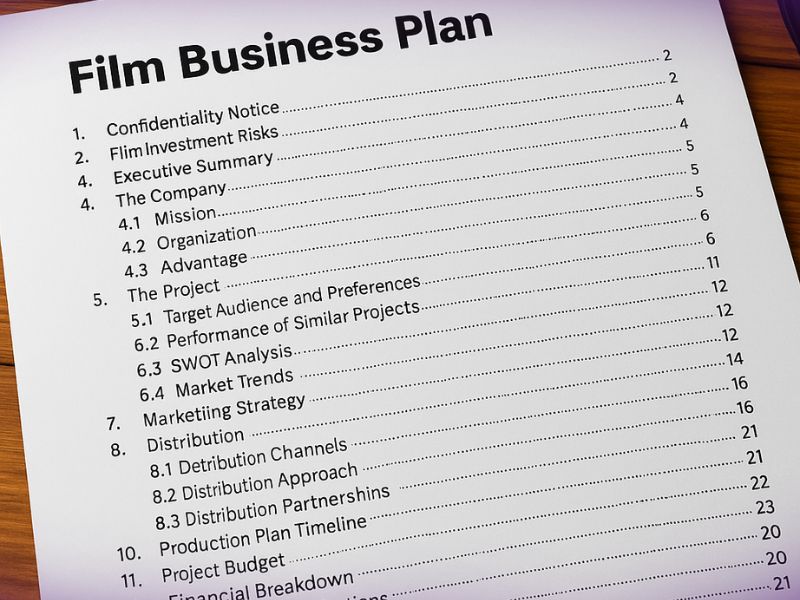
A sample film business plan typically follows this structure:
| Section | Length | Key Content |
|---|---|---|
| Cover Page | 1 page | Film title, producer/director, contact info |
| Executive Summary | 1 page | Overview of entire plan, condensed pitch |
| Project Overview | 2-3 pages | Logline, synopsis, genre, creative vision, comparables |
| Market Analysis | 2-3 pages | Audience demographics, market trends, competitive landscape |
| Creative Team | 2-3 pages | Team biographies, relevant experience, attachments |
| Production Plan | 2-3 pages | Timeline, shooting schedule, post-production workflow |
| Marketing & Distribution | 3-4 pages | Specific distribution strategies by platform, marketing approach |
| Budget Overview | 2-3 pages | Budget summary with category breakdowns |
| Financial Projections | 2-3 pages | Revenue scenarios, recoupment timeline, investor returns |
| Risk Management | 1-2 pages | SWOT analysis, identified risks, mitigation strategies |
| Appendices | Variable | Detailed budget, sample contracts, full script excerpts |
Common Film Business Plan Mistakes and How to Avoid Them
Mistake 1: Unrealistic Financial Projections
Claiming your indie drama will earn $50 million at the box office is not only unrealistic—it signals to investors you don’t understand the market.
Solution: Use real data from comparable films. If your comps earned $2-5 million total across all platforms, project similar figures. Conservative accuracy beats optimistic speculation.
Mistake 2: Vague Distribution Strategy
“We’ll get a distributor” or “It will stream somewhere” aren’t strategies.
Solution: Research specific platforms, distributors, and release approaches. Name specific streaming services, theatrical exhibitors, or alternative platforms. Show you’ve done the work to understand your options.
Mistake 3: Ignoring Risk
Pretending film production has no risks seems foolish to sophisticated investors.
Solution: Honestly identify risks and mitigation strategies. This demonstrates realistic thinking and increases investor confidence.
Mistake 4: Overestimating Team Credentials
Exaggerating your team’s experience damages credibility.
Solution: Be honest about what you’ve accomplished. If you’re emerging talent, showcase the best of what you have (awards, mentorship, relevant skills). Investors invest in people—be authentically impressive rather than falsely impressive.
Mistake 5: Neglecting International Market Potential
U.S. box office represents only a portion of potential revenue. International sales often exceed domestic.
Solution: Research international market performance of comparable films. Identify territories where your film has potential appeal. Include international distribution planning in your strategy.
Mistake 6: Forgetting Contingency and Risk Reserves
Projecting you’ll spend exactly your budget leaves zero room for inevitable surprises.
Solution: Include 10% contingency reserve. Account for production insurance, completion bond (if applicable), and financial buffers.
Mistake 7: Using Template Language
Generic business plan templates often produce cookie-cutter proposals that fail to capture your film’s unique characteristics.
Solution: Customize your plan thoroughly. Let your film’s personality and your team’s unique perspective shine through. Specific examples beat generic statements.
Mistake 8: Poor Presentation Quality
A visually unprofessional business plan suggests the production itself will be unprofessional.
Solution: Invest in professional design, clear formatting, compelling visuals, and polished presentation. First impressions matter. Your plan’s quality signals your film’s production quality.
Film Business Plan Template vs. Professional Development
When to Use a Template
DIY Templates Work For:
- Short films with modest budgets ($10,000-$50,000)
- Local funding sources understanding your market
- Passion projects where financial return isn’t primary goal
- Educational or grant-funded productions
- Test projects establishing your filmmaking credibility
DIY Film Business Plan Template benefits:
- Cost-effective (free to minimal investment)
- Full customization to your specific project
- Learning opportunity understanding business fundamentals
- Flexible timeline
When to Seek Professional Development
Professional Guidance Becomes Essential For:
- Feature films with budgets exceeding $500,000
- Productions seeking significant investor capital
- International co-production financing
- Complex financing structures (tax credits, multiple investors)
- Bank financing or completion bonds
- When investors require professional-level documentation
Professional business plan development includes:
- Industry expert guidance on realistic projections
- Access to proprietary market data and comparables
- Entertainment lawyer involvement ensuring investor protection
- Network connections to distributors and financing sources
- Investor presentation coaching and pitch deck development
The Role of Business Plans in Different Production Contexts
Feature Films
Feature film business plans emphasize:
- Established director track record or prestige
- Cast attachments (name actors increase funding probability)
- International market potential
- Theatrical or streaming platform strategies
- Long-tail ancillary revenue (TV licensing, merchandise)
- Professional completion bond considerations
Documentary Films
Documentary business plans focus on:
- Research depth and newsworthiness
- Subject matter expertise and credibility
- Grant and foundation funding sources
- Educational institutional markets
- Streaming and broadcasting partnerships
- Social impact potential attracting mission-driven funding
Short Films
Short film business plans address:
- Festival strategy and premiere positioning
- Launch pad for filmmaker careers
- Creative demonstration pieces
- Modest budget realities
- Community funding and crowdfunding approaches
- Social media virality potential
Television Series
TV series business plans require:
- Episodic production economics
- Series sustainability potential
- Network or streaming platform partnerships
- Merchandising and ancillary revenue
- International presales opportunities
- Multiple-season potential ROI calculations
Conclusion: Your Business Plan as Strategic Asset
Your film business plan is far more than a document submitted to investors. It’s a strategic thinking tool clarifying your vision, identifying challenges before they become crises, and organizing your approach to production and distribution. Even if you never show it to an investor, the process of creating a comprehensive business plan forces clarity about your project that improves your filmmaking.
Whether you’re creating a simple film business plan template for your short film, developing a comprehensive film production company business plan for ongoing operations, or building an investor-ready film business proposal for a significant production, the fundamentals remain constant: research-based realism, specific strategies over vague intentions, and honest risk assessment.
The most successful filmmakers treat their projects like businesses—not dismissively, but seriously. They understand that thoughtful planning doesn’t diminish creativity; it enables it. When logistics are clearly organized, budgets are realistic, and contingencies are prepared, creative teams can focus on what they do best: making compelling films.
For filmmakers managing their first significant production, navigating complex financing structures, or seeking professional guidance developing investor-ready documentation, expert consultation can prevent costly mistakes and accelerate your path to funding. Professional line producers and production managers bring years of experience structuring financing, managing investor relationships, and creating business plans that actually attract capital.
At First Draft Filmworks (https://firstdraftfilmworks.com/), our production team brings comprehensive expertise in film business planning and production finance. With over 8 years of experience across diverse production types, we’ve developed business plans for features, documentaries, web series, and commercial productions—helping filmmakers secure funding and bring their visions to screen.
Our Film Business Plan service provides strategic guidance, market research, financial modeling, and professional documentation tailored to your specific project and financing requirements. Whether you need a complete business plan from scratch, validation of an existing plan, or consultation on optimizing your financing approach, our team delivers professional-grade analysis that communicates your project’s viability to investors and funding bodies.
Ready to develop the business plan that secures your project’s funding? Visit https://firstdraftfilmworks.com/ to explore our Film Business Plan services and schedule a consultation with one of our production professionals today.
FAQ: Common Film Business Plan Questions
Q: How long should a film business plan be?
A: Typically 15-25 pages. Long enough to be thorough, short enough to maintain reader attention. Executive summary alone should be 1 page.
Q: Should I include my full script in the business plan?
A: Include a 1-2 page synopsis and key scenes demonstrating tone/voice. Full script goes in appendices if included. Many investors won’t read full scripts during initial review.
Q: How realistic should my financial projections be?
A: Base them on actual comparable film performance data. Conservative accuracy beats optimistic speculation. Investors recognize unrealistic projections immediately.
Q: Can I use a template for my film business plan?
A: Yes, templates work for small productions. For significant investor funding, professional development ensures credibility and completeness.
Q: Who should review my business plan before presenting to investors?
A: Line producers (budget reality), entertainment lawyers (investor protection), and experienced producers in your genre (market realism).
Q: What’s the difference between a business plan and a pitch deck?
A: A business plan is a comprehensive written document (15-25 pages). A pitch deck is a visual presentation (10-20 slides) highlighting key points from the business plan.
Q: Should I mention risks in my business plan?
A: Yes. Sophisticated investors appreciate candid risk assessment. Hiding or downplaying risks damages credibility and suggests naïveté.
Q: What if I don’t have an experienced team yet?
A: Highlight your formal training, awards/recognition, relevant experience you do have, and mentorship from established professionals. Be honestly impressive rather than falsely impressive.
Q: How should I present my business plan to potential investors?
A: Print professional copies, practice your pitch thoroughly, be prepared for detailed questions about your financials and market research, and focus on building relationship/trust beyond document details.
Q: What happens after investors read my business plan?
A: If interested, they’ll request additional information (references, legal docs, full script). They may request meetings to discuss your film and team. Be prepared for extensive due diligence.

